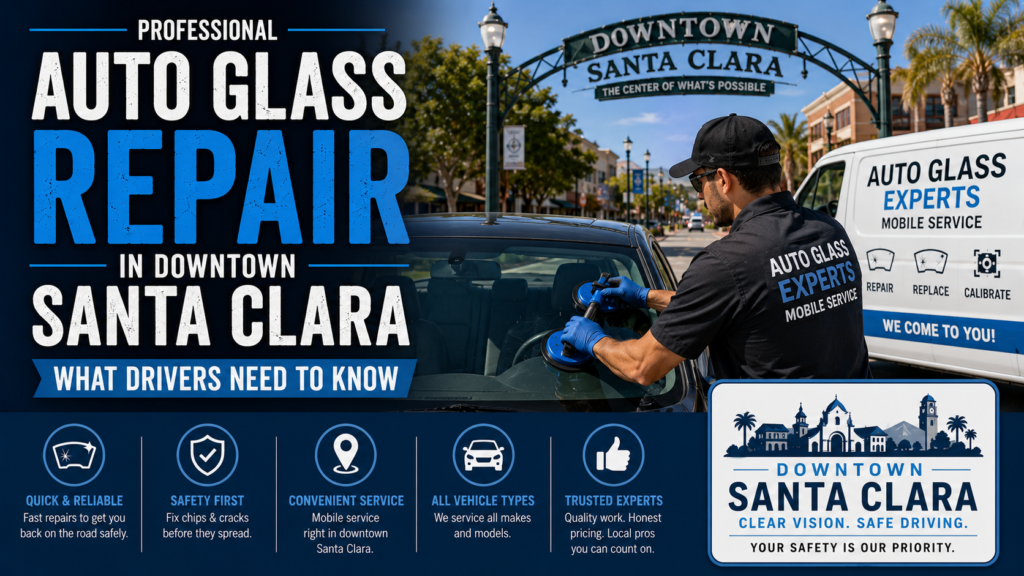
Downtown Santa Clara sits at the convergence of several major transportation corridors in the heart of Silicon Valley. With proximity to major tech campuses, sports facilities including Levi’s Stadium, retail centers, and a dense residential population, the streets of Downtown Santa Clara see continuous vehicle traffic throughout the day and into the evening. This environment, like any busy urban area, exposes vehicles to the everyday hazards that lead to auto glass damage road debris, parking lot incidents, temperature fluctuations, and occasional vandalism.
For Santa Clara drivers, understanding Auto Glass Repair Downtown Santa Clara is not merely an academic exercise. It is practical knowledge that helps them respond quickly and correctly when damage occurs, make informed decisions about repair versus replacement, and maintain the safety and condition of their vehicles. This guide explains the auto glass service process comprehensively, from initial damage assessment through completion of repair or replacement.
Auto Glass and Vehicle Structural Safety
The role of the windshield and other auto glass in vehicle safety is substantially more significant than most drivers realize. When automakers design a vehicle, the windshield is engineered as a structural component, not simply a transparent barrier.
In a collision, the windshield provides up to 45 percent of the structural integrity needed to prevent cabin crush in a rollover. It also forms the backstop against which the front passenger airbag inflates if the glass is not properly bonded to the vehicle frame, the airbag may deploy in the wrong direction, significantly reducing its effectiveness in protecting the occupant.
The laminated construction of automotive windshields two glass layers bonded with a PVB interlayer is specifically designed to keep the glass intact upon impact, preventing ejection and protecting occupants from broken glass. This structural performance depends on the glass being free of damage and properly bonded. A cracked or improperly installed windshield cannot be relied upon to perform these functions in the event of an accident.
Side windows and rear glass, made from tempered safety glass, are also important to occupant safety. In a side-impact collision, these windows help maintain the structural shell of the vehicle and, when equipped with side curtain airbags, provide the surface against which the airbag deploys.
Identifying and Assessing Windshield Damage
The first step in addressing any windshield damage is proper assessment. Not all damage is equal, and correctly characterizing the damage is essential to determining the appropriate response.
Chips are the most common form of windshield damage and are typically caused by small stones or debris striking the glass. They may appear as a single impact point, a bull’s-eye pattern, a star burst, or a combination shape. Chips smaller than one inch in diameter roughly the size of a quarter are generally candidates for repair if they are not in the driver’s direct line of sight and not near the edge of the glass.
Cracks are fractures that extend from the impact point. They may begin as a small crack emanating from a chip and extend significantly due to temperature changes, vibration, or additional stress. The Auto Glass Safety Council’s guidelines generally support repair for cracks up to six inches in non-critical locations; cracks beyond this length or in critical positions typically require full replacement.
A trained technician will evaluate the damage for size, type, depth, location, and whether the damage has extended to the inner glass layer or interlayer. This assessment takes only a few minutes but is the most important step in the entire process it determines whether the glass can be saved or must be replaced.
Chip and Crack Repair: The Technical Process
When a technician determines that a chip or crack is eligible for repair, the process that follows is a precise technical procedure that leverages modern resin chemistry to restore the glass.
Preparation is everything in windshield repair. The damage must be completely clean and dry before any resin is applied. Technicians use specialized instruments to remove debris from within the chip and may apply gentle heat to ensure any moisture within the damage has evaporated. Any residue including fingerprints can interfere with adhesion and result in a substandard repair.
A bridge-style injector or similar tool is positioned over the damage, creating a sealed chamber. A vacuum is applied to draw out any remaining air from within the damage, creating the conditions necessary for the resin to fully penetrate the crack structure. The polymer repair resin carefully formulated to match the optical and physical properties of automotive laminated glass is then injected into the void.
After the resin has filled the damage, UV light is applied to initiate curing. As the resin cures, it bonds with the surrounding glass and hardens to a state that is structurally similar to the original glass. The technician then removes the injector, clears any excess resin from the surface, and polishes the area to restore smoothness.
A well-executed repair stops the damage from spreading, restores the structural integrity of the windshield, and significantly improves the visual appearance of the chip or crack. The entire process typically takes 30 to 45 minutes, and the vehicle can be driven immediately after completion.
Full Windshield Replacement in Santa Clara
When windshield damage exceeds the parameters for repair, replacement is the only responsible course of action. Full windshield replacement is a more complex procedure than repair, but in experienced hands it is completed efficiently and with lasting results.
The technician begins by preparing the work area and protecting the vehicle’s interior surfaces. Using specialized knives and cutting tools, the existing windshield is separated from the vehicle’s pinch weld by cutting through the urethane adhesive bond. Care is taken to preserve as much of the original adhesive layer as possible, as a thin residual layer improves the bond strength of the new installation.
The pinch weld is inspected and cleaned thoroughly. Any rust, loose material, or contamination must be removed to ensure the new windshield seats properly. If rust or corrosion is found, it must be treated and primed before installation proceeds failing to do so creates a long-term vulnerability to water infiltration and bond degradation.
A fresh bead of automotive urethane adhesive is applied to the pinch weld, and the new windshield positioned using suction cups is carefully set in place. The alignment is verified, and the installation is inspected to confirm a continuous, consistent adhesive seal. The interior and exterior are then cleaned, and the technician provides the safe drive-away time the minimum period the vehicle must remain stationary to allow the adhesive to achieve adequate bond strength.
Reputable auto glass providers in Santa Clara use high-quality automotive-grade urethane and follow AGRSS (Auto Glass Replacement Safety Standards) guidelines to ensure that every replacement meets the safety standards for which the vehicle was designed.
The Technology Inside Modern Windshields
A generation ago, a windshield was essentially a flat or gently curved piece of laminated glass. Today, the windshield has become a host for multiple technologies that contribute to vehicle safety, comfort, and connectivity.
Rain Sensors: Many vehicles have rain sensors mounted near the rear-view mirror area that detect moisture on the windshield and automatically activate the wipers. The replacement windshield must include a compatible sensor preparation zone, and the sensor itself must be transferred to or reinstalled on the new glass.
Heating Elements: Some windshields incorporate fine heating wires or coatings that warm the glass from within, improving defrosting performance and visibility in cold or foggy conditions. Replacement glass must be compatible with the vehicle’s heating system.
Acoustic Interlayers: High-end vehicles often use windshields with acoustic PVB interlayers a thicker or specially formulated interlayer that reduces road and wind noise transmitted through the glass. Replacement with standard laminated glass in such a vehicle will result in increased interior noise.
HUD (Heads-Up Display) Compatibility: Vehicles equipped with heads-up display systems project information onto the windshield for the driver to view without looking away from the road. The windshield must be specifically designed with the optical characteristics required to prevent double-imaging of the HUD projection.
ADAS Cameras: As described throughout this guide, windshield-mounted cameras for ADAS features require recalibration after replacement a requirement that applies to a large and growing proportion of vehicles on Santa Clara roads today.
Side and Rear Glass: Different Material, Different Service
While windshield service is the most common auto glass need, side windows and rear glass also require professional attention when damaged. These panels are made from tempered glass a fundamentally different material that responds differently to damage and cannot be repaired in the same way as laminated windshield glass.
Tempered glass, when struck, typically either holds (for minor impacts) or shatters completely into the small, rounded fragments characteristic of safety glass. Because of this all-or-nothing behavior and the single-layer construction, there is no practical repair option for most tempered glass damage replacement is the standard response.
Replacing a side window or rear glass involves removing any remaining broken glass from the frame channels, cleaning the frame thoroughly, and installing the new glass. Side windows in power window systems must be reconnected to the regulator mechanism, which requires careful mechanical work as well as glass handling.
Rear windows with integrated defroster elements also require careful handling to preserve the electrical connections. After installation, the defroster circuit should be tested to confirm proper function.
Mobile Service for Santa Clara Drivers
The tech-forward culture of Silicon Valley has embraced mobile services across countless industries, and auto glass service is no exception. Mobile auto glass service brings a fully equipped technician directly to the customer’s location home, office, or parking structure eliminating the need to schedule time to drive to a shop.
For drivers in Downtown Santa Clara, where workday commitments are demanding and commute times are precious, mobile service offers a significant practical advantage. A technician can complete a chip repair or windshield replacement while the driver works, runs errands, or attends meetings turning an inconvenient necessity into a seamless experience.
Mobile service quality is equivalent to in-shop service when provided by properly trained and equipped technicians. The key requirements are access to the vehicle, appropriate weather conditions for adhesive curing, and a reasonably level work surface. For most Downtown Santa Clara locations office parking structures, residential driveways, or public parking areas these conditions are readily met.
Drivers should ensure that any mobile provider they work with employs AGSC-certified technicians and uses quality materials, as the convenience of mobile service should not come at the expense of the standards that govern the safety of the installation.